
The field is shrinking. The operators who stayed just got a raise.
Weak hands are unplugging and the public miners are leaving for AI. A fixed block reward split among fewer machines is a quiet raise for whoever kept theirs switched on.

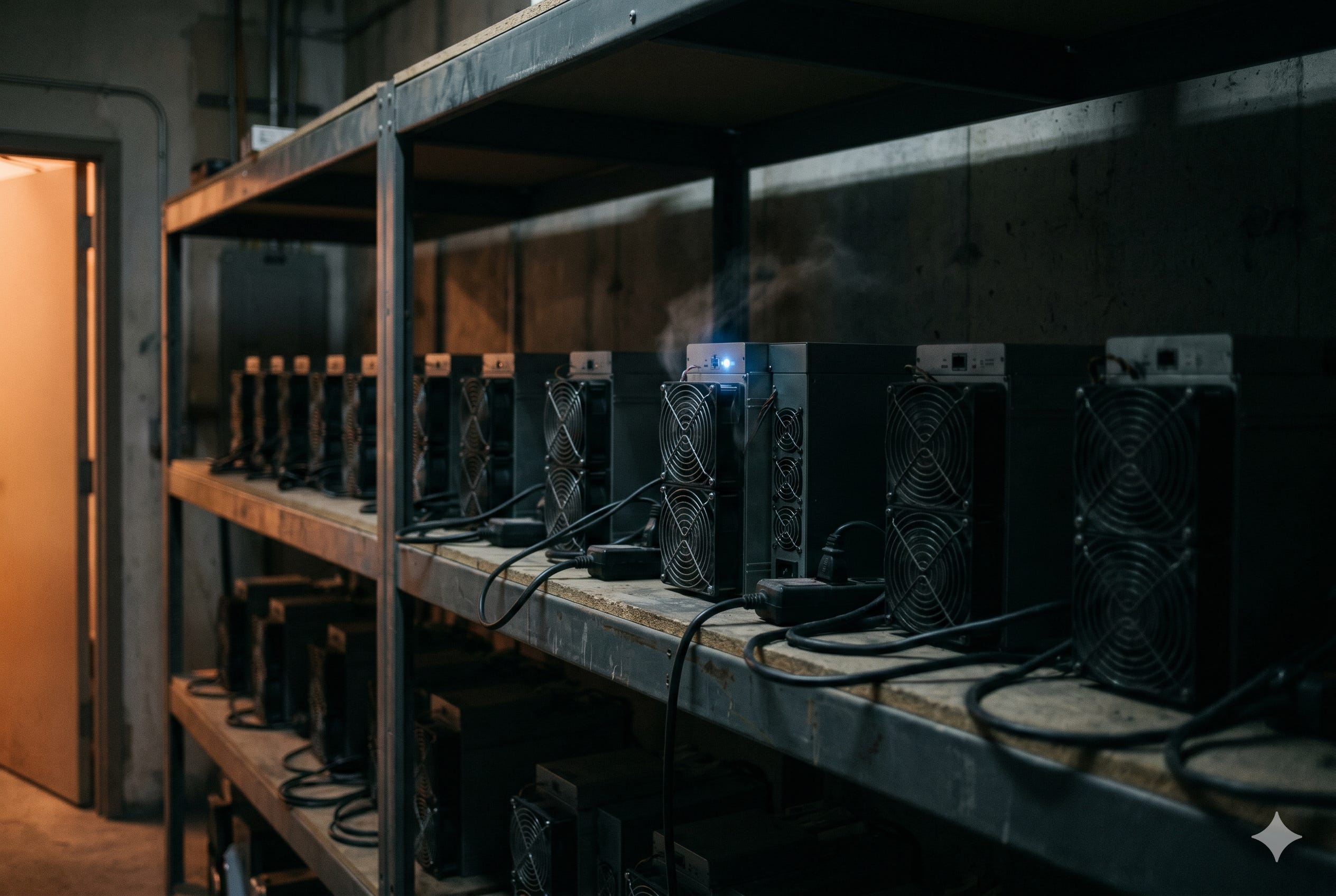
The Adjustment
Difficulty sits at about 125 T as I write this, the lowest since the middle of last year, after the network cut the target a little over 10 percent on June 13. Blocks are running a touch under ten minutes now, and the next recalibration around June 27 is set to add roughly 4 percent back. The protocol read that machines had gone dark as bitcoin slid into the low $60,000s, eased the target to pull block times toward ten, and is already clawing a sliver of that back as the survivors speed the chain up again. It does not poll the miners. It reads the block times, moves the target, and holds the cadence.
That clawback is the small half of the story. The protocol handed the operators who stayed plugged in a raise on June 13 and is quietly trimming a bit of it now. The much bigger raise came from somewhere the next adjustment can’t touch: everyone who quit.
The headlines this month are capitulation, drawdown, machines going dark. Bitcoin near $64,000, roughly half off its high. Network hashrate that was north of 1,100 exahash late last year is down around 900 now. Read one way, that is the network bleeding out.
Read from the seat of someone whose machines are still running, it is the best thing that has happened to my daily output all year.
Where the hashrate went
Two different forces are pulling machines off the network, and it matters which is which.
The first is ordinary. At sub-$80K bitcoin and a compressed hashprice, the least efficient rigs sitting on the highest power rates stop clearing their costs, so they get unplugged. That is the weak-hands half, and it reverses if price recovers. Nothing structural there.
The second half does not reverse. The largest public miners are leaving Bitcoin mining to host AI compute, and they are not coming back. The land, the power contracts, the transformers, the cooling: all of it transfers cleanly to AI and HPC, and the ten-year hosting deals pay more than mining produced even when bitcoin traded at six figures. Core Scientific is converting a Texas campus into a 1.5 gigawatt AI data center and pulling something like 300 megawatts straight out of mining to do it. That hashrate is not curtailed for the season. It is gone.
What a shrinking field pays the operator who stayed
Here is the part that reaches my wallet.
The block reward is fixed. Roughly 450 bitcoin a day get mined regardless of how many machines are pointed at the problem. When machines leave, that fixed reward is split among fewer of them, and every machine that stayed earns a larger slice of it. One of the larger US hosting operations reported that its customers are now earning around 15 percent more bitcoin per machine than they were at the start of the year. Same hardware. Same hosting bill. More bitcoin out the other end, purely because the competition thinned.
The June 13 difficulty cut is that same force wearing the protocol’s uniform. When hashrate drops, blocks come slower, and every two weeks the network notices and eases the target so the survivors mine the next stretch a little faster. A 10 percent cut works out to roughly an 11 percent bump in what each of my rigs produces, overnight, for nothing. The network is taking a small piece of that back on June 27 because the chain sped up again. Fine. But the structural piece, the part driven by machines that are never coming back, does not get clawed back at the next adjustment. It just stays.
Why I’m not buying more rigs anyway
If a shrinking field is a raise, the obvious move is to buy more machines and grab a bigger share. I am not doing that, and the reason is the whole discipline of this operation.
Below $90K bitcoin, I do not add hardware. Not because the per-machine economics aren’t improving, they clearly are, but because buying rigs is a bet on the price, and I don’t make bets on the price with this operation. The raise from a thinning field is a reason to keep the machines I already have switched on. It is not a reason to take on more capital, more hosting commitments, and more exposure at the cheap end of a range I can’t predict. Those are two completely different decisions, and the market is very good at getting operators to confuse them.
The number I run against hasn’t changed. It is still cost basis per bitcoin, hosting divided by coins produced, measured against what I would have paid buying that month. A thinner field lowers that basis for free. That is the win. Adding rigs to chase it would trade a small, durable structural edge for an unhedged price bet, which is exactly the move this operation exists to avoid.
The honest part
None of this makes the operation a money machine. Margins are thin. Hashprice is still only about $32 a petahash a day even after bouncing roughly 13 percent off its lows. Two of my three rigs sit on 0% cards whose windows close over the next several months. If a rig stops accumulating below spot for two closes running, it comes off the shelf, raise or no raise. Anyone selling you hosted mining as easy money in this tape is selling you the calculator, not the invoice.
But the quiet thing is real. The field is thinning, a meaningful chunk of it permanently, and every machine that stayed on is now mining a bigger share of a fixed reward than it was in January. Nobody sent a memo. There was no raise letter. The protocol and the exodus just handed it to whoever didn’t flinch.
I didn’t flinch. So I will take it, and I will keep taking it for exactly as long as the basis math still works.
Difficulty Adjusted is a monthly newsletter for small operators running hosted Bitcoin mining. Strategy, tax mechanics, and the math behind treating mining as a tax-advantaged bitcoin accumulation strategy. Subscribe at difficultyadjusted.io.
Mining Tracker: $79. The spreadsheet I run my own operation from, generalized for any 1–6 rig hosted miner. Download on Gumroad →
This is not financial or tax advice. Consult a CPA for your specific situation.