
Why I run a Bitcoin mining operation at a loss (and why it’s still working)
Pillar #1 · Difficulty Adjusted

The Adjustment
Difficulty sits at 139 T as I write this, network hashrate around 926 EH/s, blocks running slow at roughly eleven minutes apiece. The next recalibration, due around June 13, is set to cut the target by about 9 percent: the protocol reading that machines have come offline as bitcoin slid to $63,000 and hashprice compressed near $29 a petahash, and easing difficulty to pull block times back toward ten. Conditions for a small operator are worse today than in the month I’m about to describe. The network does not care, and it does not poll the miners. It reads the block times, moves the target, and holds the cadence regardless of how any single operator is doing.
That is the uncomfortable backdrop for this month’s question: why keep mining at a loss? The honest answer is that “loss” is measuring the wrong thing, and this piece is me changing my mind, on the page, about which numbers actually matter.
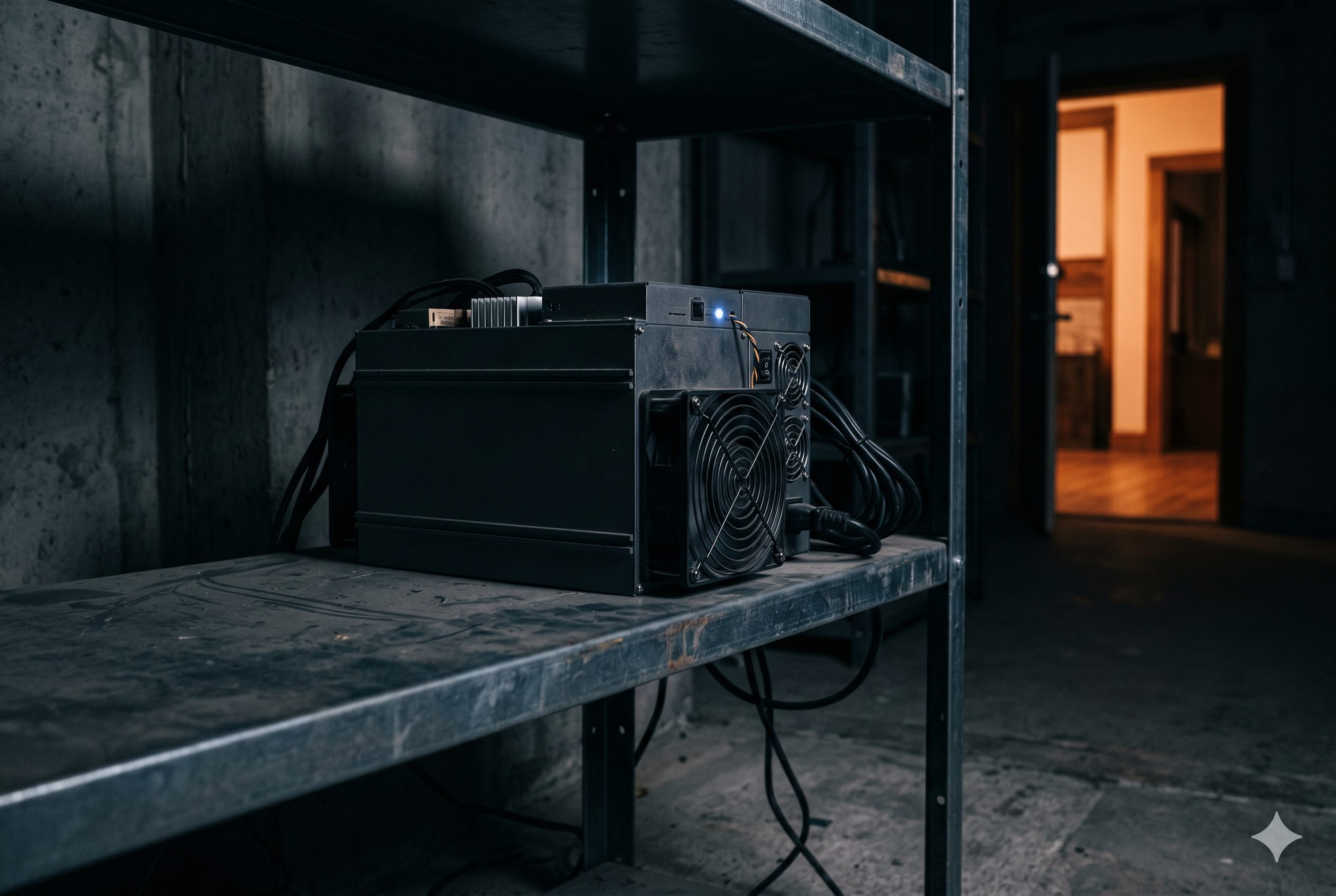
Last month my fleet “lost” money. Three rigs, about 667 TH/s combined, produced 0.00854 bitcoin on $646 of gross revenue in April. Hosting came to $568. Net for the month: $78, or about $2.61 a day across three machines.
If you read that as a profit-and-loss statement, you’d shut the operation down. Two dollars and change a day, before you account for the time spent closing the books, is not a business anyone would advise you to start.
But $78 isn’t the number I run the operation against. Here’s the one that is: $66,530. That’s what each bitcoin I mined in April actually cost me, hosting spend divided by bitcoin produced. Spot averaged $73,805 that same month. So I acquired bitcoin at roughly a $7,000 discount to what I’d have paid buying it on the open market, and that’s before the federal tax shield on the hosting deduction widens the gap further.
Read against the first number, April was a loss. Read against the second, April was a quiet win. Same month, same machines, same invoices. The only thing that changed is which number I decided was the point.
The frame is the whole game
Most writing about hosted mining is built on a hidden assumption: that the operation is an income business. Revenue minus cost equals profit, and if profit is thin or negative, the thing has failed. That framework is correct for an industrial miner running megawatts on a fixed power-purchase agreement, where the operation has to clear its own cost of capital or it dies.
It is the wrong framework for a small operator running one to six hosted rigs.
At sub-$80K bitcoin, a small hosted fleet is not an income vehicle. It’s an accumulation vehicle. The job of the operation is not to throw off cash. The job is to convert dollars I already earn at my day job into bitcoin at a cost basis below spot, on a schedule I don’t have to think about, with a tax structure that pays me back a slice of the cost. The hosting bill is not an expense eating my profit. It’s the purchase price of the bitcoin, and right now that purchase price is below market.
Once you make that swap, the decision rules change underneath you. An income business optimizes for margin. An accumulation vehicle optimizes for cost basis and consistency. An income business panics when a month goes negative on cash flow. An accumulation vehicle asks one question: did the bitcoin I added this month cost me less than buying it would have? In April, the answer was yes by about seven thousand dollars a coin. That’s the metric. Everything else is weather.
The four numbers that actually matter
When I stopped running the operation as a business and started running it as an accumulation engine, the dashboard collapsed to four numbers.
The first is cost basis per bitcoin mined: hosting cost divided by bitcoin produced. If it’s below spot, the strategy is working, full stop. April’s was $66,530 against $73,805 spot. Working.
The second is hosting as a percentage of revenue. This is the operating-efficiency read, the one number that tells me whether a given rig is drifting toward the kill line. When hosting eats most of revenue for two closes running, the rig comes off. Not because it lost money on a spreadsheet, but because a rig that no longer accumulates bitcoin below spot has stopped doing its only job.
The third is after-tax net. Mining income is ordinary income, and hosting is a deductible Schedule C expense against wage income. For an operator at a high marginal rate, the deduction is real money back. The pre-tax line and the after-tax line are different stories, and the after-tax one is the true one.
The fourth is bitcoin accumulated year to date. This is the actual goal, denominated in the actual unit. Not dollars, which lie to you every time the price moves. Bitcoin. How much more of it do I own at the end of the year than I did at the start.
The numbers I stopped watching
The flip side of finding the four numbers that matter was admitting how long I’d wasted on the ones that don’t.
Daily profit and loss, which swings on the bitcoin price and tells you nothing about a strategy measured in years. Network hashrate share, which I have no ability to change and no reason to track. Hashprice direction on a daily timeframe, which is just the bitcoin price wearing a mining costume. Public miner stock prices, which are leveraged bets on a business model that is not my business model. Spot price refreshed every hour, the most expensive habit of all, because it tempts you to make a long-game decision on a short-game feeling.
I watched every one of those numbers obsessively in 2022. None of them ever told me to do anything I was glad I did.
About that price on the screen right now
Here is where an honest version of this piece has to stop and deal with the obvious objection, because I’m publishing it in June and you can see the ticker.
When I mined that bitcoin in April, it cost me $66,530 a coin against a $73,805 spot. As I write this, spot is closer to $63,000. So the bitcoin I was so pleased to acquire “at a discount” is, marked to today’s market, underwater. If the whole argument were “I beat spot,” the market just embarrassed me.
But that was never the argument. The cost-basis comparison is made at the moment of accumulation, against the price I would otherwise have paid that month, and then it’s done. What happens to the price afterward is the same thing that happens to every bitcoin anyone has ever bought: it moves. The accumulation operator’s edge isn’t predicting that move. It’s lowering the basis on every coin acquired, every month, through whatever the price is doing, and then holding for the timeframe that makes the basis matter. A $63,000 print is not a signal to change the operation. It’s the exact environment the operation was built to keep running through. If anything, it’s the cheaper end of the range to be stacking in.
The people who get hurt at $63,000 are the ones who were running the operation against the price the whole time and just hadn’t admitted it yet.
Why this is still working
Here is the honest version, because operator honesty is the entire premise of this newsletter. The operation is thin. Two of my three rigs sit on 0% APR business cards, financed exactly so that an interest line item wouldn’t eat the margin, and those windows close over the next several months. If bitcoin keeps grinding lower, the kill rules come for the weakest rig and I let it go without a fight. None of this is a money machine. Anyone selling you hosted mining as passive income at this hashprice is selling you the calculator, not the invoice.
But the strategy is working, and it’s working precisely because I stopped measuring it against the wrong number. Every month the operation runs, I add bitcoin at a cost basis below the price that month, the tax code hands back a piece of the hosting cost, and I do it all on autopilot while I’m at my day job. The moment you stop running the operation against income and start running it against accumulation, the decisions get simpler and the strategy gets a lot more defensible.
I “lost” $78 in April. I’d do it again in a worse month than this one. In fact, that’s exactly what I’m doing.
Difficulty Adjusted is a monthly newsletter for small operators running hosted Bitcoin mining. Strategy, tax mechanics, and the math behind treating mining as a tax-advantaged bitcoin accumulation strategy. Subscribe at difficultyadjusted.io.
This is not financial or tax advice. Consult a CPA for your specific situation.